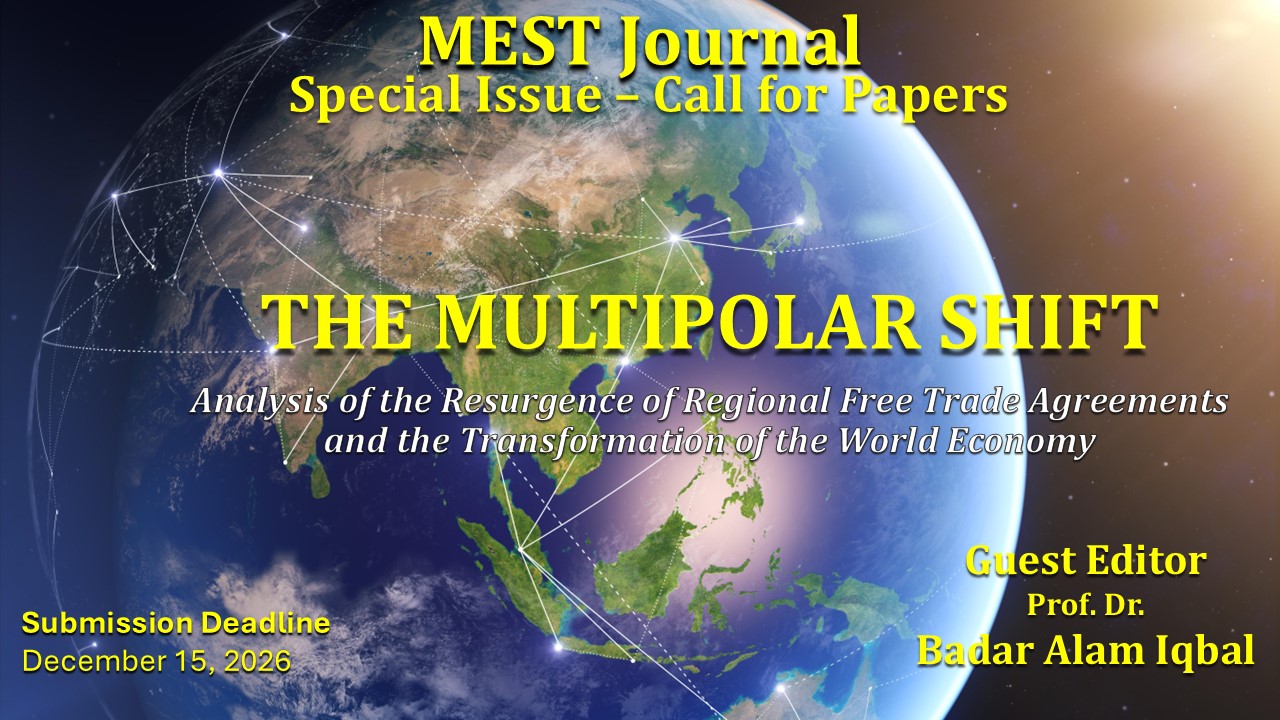
Special Issue – Call for Papers
Topic: The Multipolar Shift: Analysis of the Resurgence of Regional Free Trade Agreements and the Transformation of the World Economy
The global economy is undergoing a profound transformation as new economic and political powers challenge the long-standing dominance of the United States and Western Europe. This shift toward multipolarity is reshaping the global order and redefining the dynamics of international relations. The rise of China and India, the resurgence of Russia, and the growing influence of Brazil highlight the emergence of multiple centers of power, particularly in the sphere of international trade.
The implications of this multipolar realignment are far-reaching. Traditional Western leadership is increasingly contested, while new actors drive competition and cooperation across diverse regions. Understanding the nuances of this geopolitical transformation is essential for navigating today’s complex and evolving global landscape.
Regional Free Trade Agreements (FTAs) illustrate these changes vividly. The Regional Comprehensive Economic Partnership (RCEP)—the world’s largest free trade agreement, encompassing 15 Asia-Pacific countries including China and Japan—serves as a case study in shifting power dynamics. Alongside other agreements such as the Trans-Pacific Partnership (TPP) and the Comprehensive and Progressive Agreement for Trans-Pacific Partnership (CPTPP), RCEP underscores how globalization is being redefined, challenging the traditional dominance of Western-led frameworks like NAFTA and the European Union.
Scope of the Special Issue
- Historical context: Drivers behind the shift toward a multipolar world order.
- Implications: Economic, political, and social consequences of this transformation, including potential benefits and drawbacks of the new globalization paradigm.
- Emerging economies: Challenges and opportunities multipolarity presents for developing nations.
- Globalization redefined: The role of technology, the rise of regional trade agreements, and the growing importance of developing economies.
- Trade and investment: Effects on global value chains, trade flows, and international investment.
- Regional agreements: Analysis of TPP, CPTPP, and RCEP—their key provisions and geopolitical significance.
- Strategic motivations: Political and economic considerations behind the creation of TPP, CPTPP, and RCEP.
- Regional and global impact: Potential economic and political implications of these agreements for Asia, the Asia-Pacific, and the broader world economy.
- Business and management perspectives: Implications of multipolarity and regional integration for firms, competitiveness, innovation, and international business strategy.
Submission Deadline: December 15, 2026
Guest Editor: Prof. Dr. Badar Alam Iqbal, Monarch Business School, Zug, Switzerland